
This guide is for anyone who’s thinking about hosting a 1920s murder mystery dinner party game, or is going to join one for the first time. It’ll show you how to choose the right game for your friends, how to decorate, costume options, what food and drinks to choose, music options and anything else that might be useful.
Of all the dinner parties I’ve hosted over the years, the 1920s ones have always been the most popular and most enjoyable. And because they’re done more often, guests are more comfortable taking on the roles and getting immersed in the theatrics. The parties mostly run themselves at this point.
So, let’s not waste any more time and get straight to what you came here for:
What is a 1920s Speakeasy Murder Mystery Party?
For complete newbies, here’s a super quick breakdown of what a 1920s murder mystery is all about.
A 1920s speakeasy murder mystery party is a dinner party where guests dress as Prohibition-era characters, such as flappers, gangsters, bootleggers, jazz singers, etc. and have to look at clues and question each other to find out who the secret killer is. It normally takes place in a make-believe speakeasy, and there are usually between 1 and 3 “murders” that take place. It’s one of the most popular types of murder mystery dinner party games and every single publisher approaches their game differently, so it’ll be fun every time you play. You also get to reuse your costumes which is great in this economy.
The Prohibition-era was the time roughly between 1920 and 1933 when alcohol was made illegal, so these underground bars (speakeasies) starting popping up everywhere. Almost all murder mystery dinner parties take place in a speakeasy.
Players are all given a character sheet beforehand. This sheet will have their name, backstory, script or talking points, secrets, and costume ideas. Here’s a quick breakdown of what each of these things are:
Name – each player will be given a name to match their new character. Some kits come with name tags, so it’s easier for other players to remember who is who.
Backstory – each character will have a history. If you’re a gangster, you might have had dealing with one of the victims that were killed, making you a prime suspect. Your backstory might be only available to you, or publically stated in the opening introduction or shown through evidence later in the game.
Script – if you’re playing a scripted game, every character will have lines that they read out when asked a scripted question. In these types of games, you’re often given 2 scripts. One to read if you’re innocent and one to read if you’re guilty. You find out pretty early in the game that you’re the killer and your lines will have inconsistencies that will help players eventually identify you – if they’re paying close attention to your answers.
Talking Points – if you’re playing an improv-style dinner party game, then there’s no script to read, but every character is given things that they should try to talk about. The games evidence will usually point toward who the killer is, but talking points will give your character a specific attitude (rude, greedy, etc.) that help create a more fun atmosphere and can also help you spot the killer or reveal a secret.
Secrets – almost every dinner party game will include secrets for every player. These secrets can be things like them stealing money from the business, having an affair or even being a vampire (if you’re playing a supernatural game). On top of trying to guess the killer, players must try to figure out the secrets of other players by listening closely to the things they talk about, and from the evidence. When you openly guess someone’s secret, they have to admit to it.
Evidence – after someone dies, the host will announce that they’ve found some evidence on the body, and pull out a folder filled with items you’ll use to solve the mystery. These will be things like newspaper articles, handwritten noties, invoices, etc. that will point toward who is the murderer. The evidence will be a little vague, so you’ll still need to question each other. Evidence can also point out some interesting details about people’s lives that could help you figure out their secrets.
Costume Ideas – these are provided on the character sheets and give players ideas on what to wear. Flappers might be told to wear a flapper dress with pearls and feather in her hair, while gangsters would be told to wear a suit and some plastic rings.
Players will look at evidence that’s presented after a death and talk to each other throughout the night in order to work out who the killer is, and what secrets everyone else is keeping. After a couple hours, the game wraps up and players will fill out a voting sheet as to who they think the killer is. The host then reads out the conclusion section from their hosting booklet that will identify the killer and their motive. There’s often a few people that guess the killer correctly, so the host will choose from them who they think the winner is.
Most games come with some printable award certificates that the host can hand out to the winner. They can also give out additional awards for Best Dressed and Best Detective. Each game will come with LOTS of information on the best way to run their particular game, so don’t stress too much about remembering all of this, you’ll have detailed instructions to follow.
What Game Should You Use?
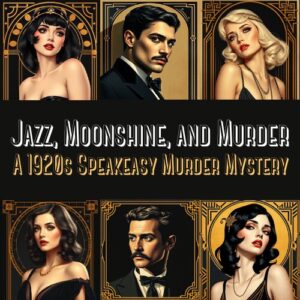
There are countless games out there to choose from. They’ve been coming out for decades, so you’re going to have to do some reading to find the best one for you. I’m a bit biased, but I do feel that our improv game is one of the best on the market. Jazz, Moonshine and Murder: A 1920s Speakeasy Murder Mystery was built to be fun and different from every single other game out there. It actually requires players to think hard when looking at the evidence in order to solve the mystery.
We’ve also implemented a points system that almost guarantees that there will only be one winner. Players get points for guessing the killer correctly, but they also get points for figuring out other characters secrets, as well as taking some Actions.
Actions are things like singing a song or saying certain words or sentences when talking to specific people. These words or sentences could easily help someone else discover their secrets, so they’ll have to slip them into conversation as carefully as possible. It’s a risk/reward gamble throughout the night. You can win by completing all your actions, or help someone else to win when they catch you out.
Our game is completely printable, so it’s available worldwide. We also ensure that every single character is gender-neutral. This simply means that you don’t have to have a specific number of men or women attending your party in order to play the game. A normal game might have 5 male characters, 5 female characters and 3 gender-neutral characters. In order to play the game, you’ll have to have 5 men and 5 women, and the remaining spots can be filled by anyone else that shows up. With our games, all 20 characters are gender-neutral, so invite whoever you want to.
Lastly, we have zero romantic relationships between characters. This means that no guest is ever going to be made uncomfortable by an unwelcome advance that’s been added to another characters backstory, talking points, or actions. It makes work events and family gatherings conflict free and let’s everyone have a great time.
Every game is made for a specific number of people. Our games are all for 8-20 people. So, depending on the number of people you plan to invite, you’ll need to shop to find a game that will accommodate your group. Some games online can cater for over 50 people.
How Many People Do You Need?
This really depends on you and how big you want your party to be. But I’d say for first-timers, go for 8-10 people and for those that have hosted before, 10-14 people works best in my experience.
Always make sure that the game you choose will have enough characters to cover all the people you plan to invite. There are generally 2 types of characters in these games, your primary characters and your secondary characters.
Primary characters MUST show up on that night. They are usually the first 10 players in a game, but in our games they are the first 8 characters. These people will have important secrets, possibly important lines, and will be the murderer or one of the victims. When choosing people to attend, only give these roles to players that you are certain will show up.
Secondary players still have secrets and a strong backstory, but if they cancel last-minute, it wont negatively affect your night. Players are completely unaware of whether they are primary or secondary characters. Usually with these types of games, after you’ve selected which friends are taking the primary spots, you can choose any of the secondary characters to join your game – meaning that you don’t have to use them in the order they’re given on your sheet. If characters 11-20 are secondary characters, but you really want character 19 (the doctor) to be a part of the game, you can simply assign that character to a friend.
Planning the Party – Timelines and Invites
Give yourself at least three weeks to plan properly. If you try to host in the same week that you buy your game, you’re going to have a bad night. Friends will need to check their calendars to make sure they’re definitely available, book babysitters and find time to buy their costume. It’s definitely not a last-minute type of game.
A rough planning timeline:
- 3 weeks before: Choose your kit, buy it, and read through all the host instructions.
- 2 weeks before: Assign characters, and send out invitations with a copy of their character sheet. Include costume advice if not on their character sheet.
- 1 week before: Get guests to RSVP, plan your food/snacks, buy your costume, buy decorations, and choose what background music you’d like.
- 3 days before: Print all character sheets (preferably on cardstock), and print all evidence, nametags, awards, etc.
- Day of: Put up your decorations, put out your food or snacks, queue the music, and get into character.
Sending character sheets out early gives players a chance to plan their schedule, think of ways to play their character and time to buy, borrow or make their costume. Guests who arrive already thinking like their character will make the game much more interesting.
Decorating Ideas + Props
Some people go all out for decor, but I like to keep things simple. You want to create a nice atmosphere, but you don’t need to break the bank for a single night. Grab a few small items for your first party, and with each new party, you can add a little more. It won’t be long until you have a closet full of decorations.
The easiest 1920s speakeasy items to add are:
- Black and gold color tablecloths, napkins, and candles
- Vintage-style posters on the walls (movie posters, wanted notices, fake newspaper headlines)
- Low, warm lighting – electric candles work well
- A makeshift bar area with old labels on bottles
These are all items that you can find at any party store or print out for free with our templates.
We’ve created a bunch of free templates that you can edit and use for your next party. You can add your friends names to posters, add clues to them, or simply print them out as is and hang them on the wall. You can find all of these at our article: 1920s speakeasy decor on a budget.
Costumes – What Should Guests Wear?
The 1920s are one of the easiest parties to dress up for, and your costume is pretty much reusable forever. There are premade costumes available in party stores, and online, or you can simply put some items from you wardrobe together and make something just as good.
Women can easily get aways with a dress and some fake pearls, while men can go with a pinstripe suit and a bowtie. If players really want to go all-out, they will find countless accessories in party stores to accessorize with. As one of the biggest types of dinner parties, party stores have learned to cater for every type of character.
For 10 specific costume ideas with details on how to put each look together, see our top 10 1920s costume ideas. If you’d prefer to keep your budget tight and not shop at all, here’s out guide on building a 1920s costume from your own closet
Food and Drinks for the Night
With any murder mystery dinner party, you’ll need to decide if you want to serve a full meal or go with just snacks. I ALWAYS recommend going with just snacks, as I find the whole cooking / catering part way too stressful. Most games are designed for players to be moving around the space talking to each other in smaller groups, not sitting next to each other and shouting across a table.
Some easy options you could try are deviled eggs, sliced cured meats, cheese boards, small sandwiches, olives, and stuffed mushrooms. Alternatively, order some pizzas, print out a funny 1920s names for each pizza and call it a day.
For drinks, there are some easy Prohibition-era cocktails and mocktails that you can make. The Bee’s Knees (gin, lemon juice, honey), the Southside (gin, mint, lemon), and the French 75 (gin or cognac, champagne, lemon) are all favorites of mine. None of them requires any bartending experience.
For step-by-step instructions on five easy Prohibition cocktails that you can make ahead of time, see our Prohibition-era cocktail guide. Each recipe is simple enough to batch in large quantities, which saves a lot of time when you’re also managing a party.
Music – Setting the Mood
Music is the quickest way to get people comfortable and into character. Jazz is your best option as it’s the music that was prevalent in the 1920s. You can find countless free playlists on Youtube and Spotify to use for that night and either put it on repeat or have two or three playlists ready to go.
To make things a little easier, we’ve put together a free jazz music playlist that you can play on Youtube. They’re all original, non-copyrighted music, so even if you record clips from your evening and post them on Youtube someday, you won’t get any copyright strikes. Listen to it in advance and see if it’s something you enjoy. If not, you’ve still got plenty of time to find the right music for you.
While jazz is what everyone goes for, you don’t have to force yourself to listen to anything you don’t want to. Try out some light piano tunes or even go for something modern. The only recommendation I’d add is to make sure that the music doesn’t have lyrics. I sing along to all songs, either out loud or in my head and hear absolutely nothing that’s happening around me, and there are many people with the same problem. Avoid breaking peoples concentration by only playing instrumental music at a low volume.
1920s Language – Getting Guests into Character
This one is completely optional and definitely not necessary, but if you want to learn some fun words and phrases to throw into your conversations, we’ve got a few that you might like.
Some terms to get you started:
- Bee’s knees – excellent, outstanding
- Bluenose – someone who disapproves of fun or alcohol; a moralist
- Beeswax – business, as in “none of your beeswax”
- Horsefeathers – nonsense, rubbish
- Coppers – police
- Giggle water – alcohol
- Hooch – illegally distilled liquor
- Jane – a girl or woman
- Jake – fine, okay
- Kisser – the mouth
If you’re having a seated dinner, these can be printed out and left on the dinner table for players to learn a few quick words to make their characters more lively. For a longer list that includes insults, compliments, and some character-specific phrases, see our full guide to 1920s slang for your speakeasy party.
How to Run the Night – A Step-by-Step Flow
The structure of a murder mystery dinner party tends to follow a similar pattern regardless of the kit. Here’s a general plan of how a 1920s speakeasy evening would play out:
Before guests arrive (30-60 minutes before): Room is decorated, music is playing, drinks are available, snacks are out or food nearly ready. Have a printed copy of each guest’s character sheet ready to hand to them on arrival.
Arrival and mingling (first 30-45 minutes): Guests arrive, have a drink, and receive a fresh copy of their character sheet from you. Players will chat in-character to each other, and get more used to the character they’re playing. The host will read the introduction from their host booklet that will explain where players are, what’s happening around them, and the rules of play.
Murder announcement: At a certain time of the night, the host will go over to a person that’s been marked off in their booklet and tell them that they’ve been killed and need to act out being stabbed, shot or poisoned. When that player is on the floor, the host announces that they’ve found some evidence and will pull out some pages of pre-printed evidence and pass it around for everyone to read. Usually, the dead player will stand up and continue investigating as a ghost. Some games have up to 3 deaths, so there’s a lot of fun death scenes to record.
Clue reveals: If you’re playing a scripted game, then you’ll have different rounds of asking questions from your script. Each round will reveal some important evidence that is required to figure out who the killer is. If you’re playing a non-scripted (improv) murder mystery game, then you’ll just mingle and talk to people between deaths and discuss the evidence with each other – trying to make sense of. Clues found on bodies are usually a bit cryptic or need you to speak to people at the party to make sense of it.
Accusation round: This is near the end of the game. The host hands out cards for players to write down who they think the killer is. They’ll then do a check and see how many people managed to get it right.
Reveal and prizes: Right at the end of the game, the host will read the conclusion section from their booklet that will reveal the identity of the killer and the reasons for why they did it. Award certificates (that you’ve pre-printed) are handed out for the correct guesser, best costume, and best actor. You can also add a small prize like a chocolate or something to go with it. Here are some inexpensive murder mystery prize ideas for your dinner party game.
The whole evening will be over in about 2 to 3 hours depending on how big your group is. Most games will come with a general timelines to follow, but you can do things faster or slower depending on how everyone’s mood.
Hosting a 1920s Speakeasy Party at Christmas
Christmas time is one of my favorite times of the year. Most people have a bit of extra time if they’ve taken holidays, so it can be a great time to host a dinner party. I like to take things to the next level by making it into a 1920s murder mystery dinner party. I don’t often force dress-up during this time unless friends want to, as guests may want to come in their Christmas attire for the party.
Gold and black decorations work well for both the 1920s and for Christmas, so lots of gold tinsel can go up on the walls, and I swap out the jazz music for some instrumental Christmas music.
For specific ideas on how to combine Christmas and 1920s themes – decor, food, etc. – see our 1920s speakeasy Christmas party guide.
Speakeasy Party vs Standard Murder Mystery Dinner
| Feature | 1920s Speakeasy Party | Standard Murder Mystery Dinner |
|---|---|---|
| Setting | Speakeasy, Prohibition-era America | Varies (manor house, cruise ship, etc.) |
| Character types | Flappers, gangsters, bootleggers, jazz musicians | Depends on theme |
| Costume difficulty | Easy – many pieces easily sourced or owned | Harder – varies by theme |
| Decoration difficulty | Easy – black and gold, vintage posters | Depends – varies by theme |
| Drink types | Prohibition cocktails or hard liquor | Anything goes unless themed |
| Music options | 1920s jazz or any piano music | Depends on theme |
| Roleplay intensity | High – era-specific slang and character types | Medium – depends on kit |
| Best group size | 10 to 14 players | 10-14 players |
A Note on Group Type
The 1920s theme works for most parties, including birthdays, work events, reunions, etc. It’s glamorous but still easy enough to put together as its popularity has led to lots of decorations and costumes being available. If you go with an improv style game, then it’s more relaxed as players spend time mingling instead of reading from a script.
When you have 8 or more friends that want to hang out for a few hours, then these games are the perfect format. It gets less fun with fewer people, and harder to find kits that cater for that. If it’s 1-4 people hanging out, then you’d be much better off with a murder mystery case file that lets players solve a murder by looking at evidence, solving puzzles and deciphering secret codes. These can be played as soon as you print them out. There’s no pre-planning, dressing up, acting or character roles to take on.
Frequently Asked Questions
What is a speakeasy murder mystery party?
A speakeasy murder mystery party is a 1920s-themed dinner party where guests dress up as characters from the game and try to solve a murder. There are both scripted and improv style types of games that play differently to each other. Games typically take 2-3 hours to play.
How many guests do I need for a 1920s murder mystery party?
The best 1920s murder mystery kits are designed for 8 to 20 players. I’d recommend sticking to about 10 people on your first time.
How long does a 1920s murder mystery party last?
A full evening with dinner runs 2 to 3 hours, unless you’re having a full dinner, in which case it will depend on how many courses.
Do guests need acting experience for a speakeasy murder mystery?
No. Improv-style murder mystery games give each guest a character profile sheet with talking points and a backstory. You simply mingle as normal and do your best to keep to the style of your character.
What is the best 1920s murder mystery game to use?
The best 1920s murder mystery game is one that fits your player count, uses an improv format (no scripted questions to read), and comes with detailed character cards. Our Jazz, Moonshine and Murder kit was designed specifically for this. It’s for 8 to 20 players, has non-gendered characters so any guest can play any character and there are no romantic relationships between players, so no uncomfortable moments.
What food should I serve at a 1920s murder mystery party?
I alway recommend to go with finger foods. You’ll have enough to do as host than to still worry about meal courses. Good options are deviled eggs, cured meats, cheese and crackers, stuffed mushrooms, small sandwiches, olives or even pizza. For drinks, Prohibition cocktails like the Bee’s Knees, Southside, and French 75 are easy to make in bulk. Full recipes are in our Prohibition cocktail guide.
Can I use the same kit more than once?
Not with the same group of friends, as they’ll know the ending. But you can use it with a new group of friends. Of course, you’ll now know who the killer is, as well as the secrets of everyone, but I still have a great time as the host playing this way, and have more time to take photos of everone.

Sherwin has been creating amazing murder mystery case files since 2023 – and he has no plans to ever stop. His cases have earned rave reviews from players around the world, and he’s since expanded into full murder mystery dinner party games. With 10 years of experience under his belt creating digital products, he brings a sharp eye for design and detail to every crime scene he builds.