Murder Mystery Case Files vs Escape Room Games – What’s the Difference?
Both are detective games to play at home. But they work very differently. This is a direct comparison of the two – mechanics, play time, and which one to choose based on what kind of experience you’re looking for – ie. more deduction-focused or more puzzle-focused.
Escape room box games are puzzle-focused and code-based challenges with very little story. Murder mystery case files are evidence-based investigations with large intricate stories, and require reading, reasoning, and deduction. Newer one often include some puzzles and secret codes as well. Both can be played with 1-4 players.
Escape Room Games vs. Murder Mystery Case Files
If you’ve ever been to a real-life escape room, then you’ll already have an idea of what these at-home versions are like. It’s usually bought as a box that contains multiple puzzles and secret codes that need to be solved. People that love puzzles and are patient will enjoy these games the most. Some even contain physical props like combination locks that you’ll need to physically open by finding the right combination. You’re often required to cut, fold, and mark items in your box in order to complete them, so games can only be played one-time. Games in this genre are usually 1-2 hours long.
A murder mystery case file is an investigation game that requires you to look through evidence, such as suspect interrogations, crime scene photographs, coded letters, maps, fingerprints, autopsy reports, etc. and try to solve multiple objectives that lead to finding who committed the crime. Newer games such as ours also include puzzles and secret codes that you’ll need to complete in order to solve the case. These games are usually 2-4 hours long, and can be reprinted after drawing on them and reused with other friends.
Head-to-Head Comparison
| Factor | Escape Room Box Games | Murder Mystery Case Files |
|---|---|---|
| Core mechanic | Puzzles, Codes | Deduction, Puzzles, Codes |
| Experience type | Puzzle challenge | Detective investigation with Some Puzzles |
| Play time | 1-2 hrs per box | 2-4 hrs per case |
| Cost | $20-40 per box | $8-16 (printable) / $25-35 (physical) |
| Players | 1-4 | 1-4 |
| Solo play | Yes | Yes |
| Rules to learn | Simple mechanics (5-10 min) | Simple instructions (1 min) |
| Component destruction | Yes | No, if printable | Sometimes, if physical |
| Replayable | No (solution is known) | No (solution is known) |
| Narrative depth | Light story, lots of puzzles | Deep detective case, fewer puzzles |
| Online Component | Often, yes | Often, yes for hints and answers |
Escape Room Box Games – What They Do Well
I love escape room games. I play them both using physical media and on my phone and laptop. Video games like The Room got me into these types of games and I’ve been playing them ever since.
Escape rooms games don’t have a lot of story, but that’s really not the point of them. They’re designed to throw as many puzzles as possible at you, and have you stumped while you try to figure them out. These aren’t game for impatient people.
One important thing to note is that unlike video games, the physical games are destructive. This simply means that you will have to cut cards, fold pages, and mark some parts of the game in order to solve the puzzles. When you finish, the items can never be used again. You cannot pass it to a friend or play it again. How much that matters depends on how comfortable you are with a single-use experience. I really don’t mind too much as long as the price is not too high. It’s the equivalent of paying to go watch a movie at a cinema.
Murder Mystery Case Files – What They Do Well
Case files are built for people that want to take on the role of an investigator. If you’ve ever read a murder mystery novel or watched a movie, and were shouting at the main character for following the wrong clues – then this is the type of game you’ll enjoy.
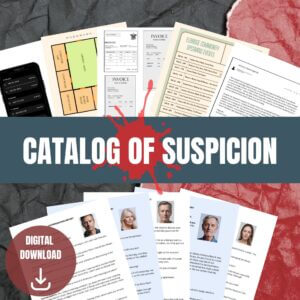
At Print Mysteries, we include coded puzzles into our investigations to give them a hybrid feel. You get some escape room puzzles as well as deep mystery to solve. Catalog of Suspicion, our most difficult case, includes cryptic coded messages that need to be deciphered in order to complete some of the 6 objectives. Every case has puzzles, so I strongly suggest you start with other cases and save Catalog of Suspicion for dead last, as it’s meant to stump you for hours.
Case files also run longer than escape rooms. Our cases usually take between 2-4 hours to complete. You can write on and circle as many clues on-page as you like, as pages can always be reprinted.
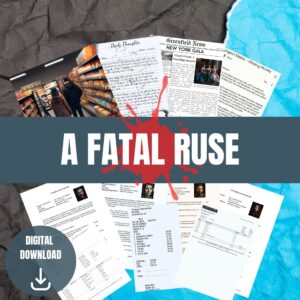
Print Mysteries builds cases that deliberately combine both mechanics. The cases include investigative evidence alongside coded puzzles and cryptic documents – escape room puzzle elements embedded within a murder investigation story. This means players who enjoy both formats tend to find Print Mysteries cases cover all the bases for a fun weekend activity.
For a deeper look at how printable escape-and-solve cases work specifically, this article goes into the full mechanics of how the two formats blend into a single game.
What I’ve Noticed Since Designing These Games
Print Mysteries cases include escape room puzzle elements – coded messages, puzzles, etc. because I find these types of games more interesting. There are people that prefer their games to only have investigation clues and nothing else. There are tons of games like that on the market, so you’ll always have something new to play. My cases are designed to give you a complete experience that you can spend a full evening enjoying.
I think people that enjoy regular murder mystery cases will find extra enjoyment in Print Mysteries case files, as they add an extra layer of puzzles but without taking anything away. To do this, I’ve simply expanded the number of objectives to complete. Our largest game has 7 objectives, with each objective having multiple steps within to complete it.
Related Reading
Escape room games are covered in our detective games buyer’s guide alongside every other format so you can find the best products for your money.
If escape rooms aren’t the right fit, detective board games vs case files covers the next closest alternatives.
And finally, here’s the full printable game breakdown – covering game night formats, solo options, and what products are a bang for your buck.
Frequently Asked Questions
A murder mystery case file is an evidence-based investigation. You’ll use mostly deduction to find the killer, but cases can have puzzles and secret codes thrown in. YAn escape room box game is purely a puzzle-solving game – you crack coded, solve puzzles and open locks in order to complete it. There usually isn’t much story.
Yes, definitely. Boxes games often have physical props that you can move, cut, write on and even break in order to solve puzzles – just like the ones in real life. They’re also significantly cheaper and can be played alone (unlike venue escape rooms).
No. Once you know the outcome, the game is essentially over. You’ll often need to cut up, write on, and bend items in your box in order to complete your escape room, which means that it is only playable once (just like a venue escape room).
Escape room box games usually take around 1-2 hours per box. Murder mystery case files usually take 2-4 hours per case. Times can change drastically depending on how many people are playing as these games can have 1-4 players.