Murder Mystery Escape Room Games – Printable Escape-and-Solve Cases
There’s also a hybrid version that’s called escape-and-solve games. This is what we’re going to focus on. That format combines two categories that people usually enjoy separately – escape rooms and murder mystery case files. Escape rooms are very puzzle-heavy games and can be extremely challenging. Murder mystery cases have a great story, interesting characters, and tons of realistic evidence to work through. Combining them gives you the best of both worlds at a single price point.
I started designing these types games after getting frustrated with two things that I found in the games I bought: traditional murder mystery cases that often required me to know certain general knowledge facts to proceed, and escape rooms that felt boring without a decent story backing them. My format fixes both problems by combining an epic story and mystery (that have everything you need to solve it already on the pages), with interesting puzzles.
Physical Escape Rooms vs. Printable Escape-and-Solve Cases
When people search for “murder mystery escape room games,” they’re going to get bombarded with a ton of unrelated results. The Google algorithm is incapable of differentiating between the multitude of murder mystery games. If you’re confused by the mishmash of results, check out our full breakdown of the different types of murder mystery games. It’ll make searching going forward much easier. For now, let’s break down the differences between physical (in-person) escape rooms and printable escape-and-solve games (hybrid of murder mystery case files and escape rooms).
| Feature | Physical Escape Room (Venue) | Printable Escape-and-Solve Case |
|---|---|---|
| Where you play | A room specificall built for this person that you travel to | At home on your coffee table |
| Booking required | Yes – in advance, specific time slot | No – play any time you want |
| Time limit | Usually 60 minutes, strict | 2-4 hours – but you can play at your own pace |
| Players | Usually 2-8 (venue-dependent) | 1-4 (great for solo players) |
| Cost | $25-$40 per person per session | $8-$50 for the full case file (unlimited plays) |
| Physical props | Purpose-built set, physical locks, UV lights | Printed evidence, maps, coded documents |
| Story depth | Varies – some rich, some minimal | Full murder narrative with developed characters |
| Availability | Location-dependent, limited themes | Available worldwide as instant download |
| Best for | Group event, social outing, birthday | Group game night, date night, solo play |
Neither format is better than the other as they serve different occasions. A physical escape room is a social event that you organize in advance during the day when friends have time off work and live close-by. It’s usually designed with minimal story, but lots of fun puzzles. As you’re in-person, you might be allowed to take photos and videos of your friends trying to solve puzzles. A printable escape-and-solve is something you can play any night after work with friends that are local or online. They’re much longer and in-depth and usually take up a full evening. Full a full breakdown of the differences between murder mystery case files, escape rooms and escape-and-solve games, check out our puzzle-focused murder mystery games article where we break everything down as clearly as possible.
What Was Wrong with Traditional Murder Mystery Case Files
Before I started designing printable escape-and-solve cases, I played through a lot of murder mystery case files that left me frustrated. The problems were consistent across different products.
- Clues required outside knowledge to solve – you had to Google medications, obscure facts, or specific technical terms not provided in the case
- No structured progression – you were given everything at once and had to figure out where to start, many times following plot holes that were never meant to be there
- One-shot reveal – if you guessed the killer wrong, the game told you the answer and immediately ended. The ending was ruined before you could go back and figure out what you missed
- Passive evidence reading – pages and pages of text with clues hidden inside statements, no puzzles or codes to break up the investigation
- All required information is on the pages provided – no Googling, no outside knowledge assumed
- Structured by objectives – new evidence only unlocks after completing each previous objectives, so you always know exactly where you are in the case
- Multiple-choice answers prevent accidental reveals – you’re told if you get an objective wrong but not given the correct answer, so you can try again
- Puzzles and codes added – codes, ciphers, spatial puzzles, and logical deductions break up the evidence reading
Types of Objectives in an Escape-and-Solve Case
The variety of objectives in my cases is what gives them such strong escape room vibes. Each one will be completely unique to the last objective, and moreso, completely unique to any other case you might have played. Expect a lot of logic-puzzle solving inside these escape cases – but the logic puzzles are embedded into an epic murder investigation in interesting locations with fun characters.
The Self-Contained Evidence Principle
One design rule that every Print Mysteries case follows: if you need to know something to solve any objective, that information is in the case file soemwhere. You’ll never have to Google anything or have any prior knowledge of the topic. If the case involves a medication, a date in history, or strange terminology – there’ll be a reference to it somewhere in the case, even if it’s in a newspaper ad for a flower shop.
This matters more than it sounds. Traditional murder mysteries that require you to have outside knowledge are fundamentally unfair to players who don’t happen to know that specific fact or who don’t want to spend an hour Googling the names of every strange medication they come across. It turns a deduction game into a general knowledge test. Escape rooms usually never have this problem – every puzzle has a solvable answer using information in the room or on the page. Printable escape-and-solve cases follow the same principle.
Which Cases Have the Strongest Escape Room Mechanics
All Print Mysteries cases use a sequential objective structure. You must complete objective 1 before moving to objective 2. But some lean way more heavily into the puzzle mechanics than others. Here’s how the collection breaks down for players coming specifically from an escape room background.
Very hard difficulty. 6 objectives. It’s heavily puzzle-focused – coded messages, cryptic clues, and pattern-based challenges throughout. 37 optional hints (the most in the collection) because the puzzle difficulty is so high. Built only for players who found other cases too light on escape-room-style mechanics.
Hard difficulty. 6 objectives. 22 evidence pieces across 40 pages. Strong mix of investigation and puzzles. A good starting point for escape room fans new to case files – it’s hard enough to challenge experienced puzzle-solvers, but with a great story to reward the investigation side too.
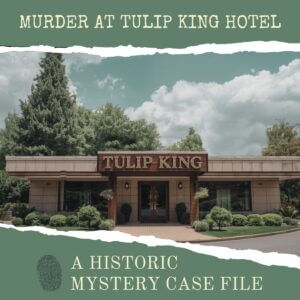
Medium-hard. 6 objectives. The coded notes and shredded document reconstruction in later objectives are the most physically hands-on puzzle work in the collection. It’s also has a deep story that complements the puzzles and will keep you invested in the full length of the game, which could take 3-4 hours to complete.
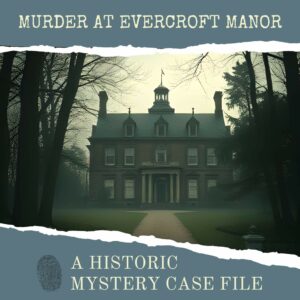
Medium difficulty. 4 objectives. If you’ve never played a case file and want to understand the format before trying a harder puzzle-focused case, start here. Medium is not easy, there’s a definite challenge here. The objective structure and hint system are the same across all cases. One objective can have multiple parts to it.
Why Printable Rather Than Physical
Physical escape room box sets – the kind that come with UV pens, physical envelopes, and objects to manipulate – are a premium experience. They’re excellent gifts and can sometimes be worth the higher price point for the right event. The tradeoff is cost, availability, and the fact that once you’ve opened the box, the game is played once and the physical materials are used up. You usually have to throw it away instead of keeping it for friends or your kids to try it.
Printable escape-and-solve cases solve these issues. You print everything at home, which means you can print multiple copies for a larger group, you can reprint a page if someone spills coffee on it, and you can take notes directly on the evidence without worrying about damaging any physical props. You can also reprint the game years later for your kids, or once you’ve forgotten the solutions. The download is available worldwide minutes after purchase – no waiting or extra charges for international shipping.
I’ve lived in different countries over the years and know how frustrating it is to find a game you really want to play, but it doesn’t ship to where you live. Printable cases now remove that limitation entirely. As long as you have a printer available, you have access to the full experience.
Frequently Asked Questions
What is a murder mystery escape-and-solve game?
A murder mystery escape room game is a hybrid format that combines murder mystery case files with escape room puzzles. Players work through multiple objectives – each involving a different type of puzzle or investigation – to eventually identify a killer. You get puzzles, codes, investigation and a deep story. Printable escape-and-solve cases are played at home without time limits, booked sessions, or venue requirements.
How is a printable escape-and-solve case different from a physical escape room?
Physical escape rooms happen at a specific venue with a strict time limit, purpose-built props, and a booking requirement. Printable escape-and-solve cases are PDF downloads. You print them at home, play at your own pace, and can print out additional copies for bigger groups. Physical escape rooms cost $25-$40 per person per session. Printable cases cost $8-$16 total for as many people as you invite over. Physical escape rooms often require a minimum of two people to play. Printable cases work great for solo players, date nights, and small groups at home.
Do murder mystery escape-and-solve games require outside knowledge to solve?
No. Every Print Mysteries case is designed so that all the information you need to solve each objective can be found the case file. If a case involves a specific fact – there’ll be a mention of it somewhere in the case. You should never need to search online to solve an objective. This is a deliberate design principle that I include in every product I make: every puzzle has a fair, solvable answer using only the information available on-page.
What happens if you get an objective wrong?
The online answer system tells you your answer is incorrect and tells you to try again. You are not shown the correct answer. Every answer sheet has a multiple-choice format, which means you can eliminate wrong answers one at a time without the risk of accidentally seeing the solution. There’s also a hint system if you get stuck. Hints start vague and slowly get more specific with each one.
Which Print Mysteries case is most like a traditional escape room?
Catalog of Suspicion is the most puzzle-heavy case in the collection – it has a very hard difficulty rating, 6 objectives, coded messages, cryptic clues, and 37 optional hints because you’re almost guaranteed to get stuck. Murder at Tulip King Hotel has the most physically hands-on puzzle work, particularly in later objectives, where you’ll need to reassemble shredded documents. Both are better suited to experienced players who have already completed at least one medium-difficulty case to get a feel for our game design.
Can these cases be played with the same group multiple times?
No. Once a group has solved a case and knows who the killer is and the solution to each objective, you can’t really replay it. However, because the cases are printable PDFs, you can always reprint them for your kids to try when they’re old enough and to play years later when you’ve forgotten all the answers.