
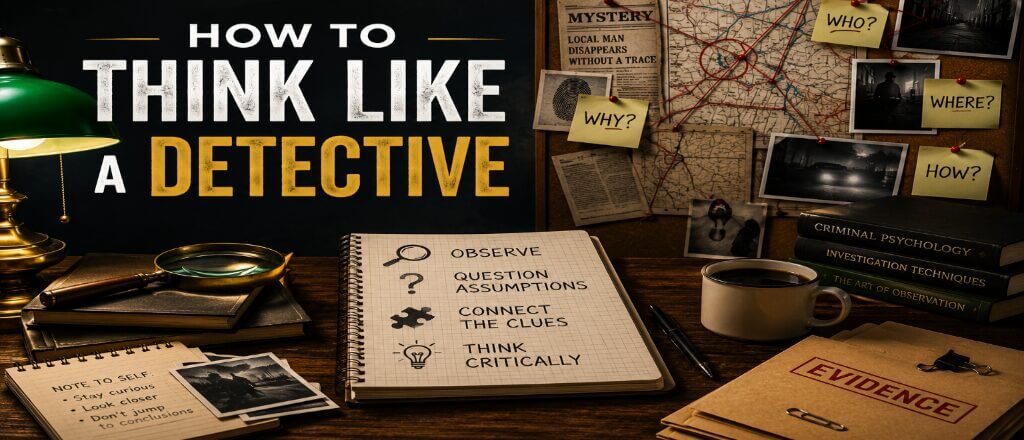
I’ve spent years designing murder mystery case files – designing clues, creating red herrings and trying to make my cases as interesting and fun as possible. I’ve made them at different difficulty levels to suit a variety of skill levels. The feedback I’ve received has taught me a lot about about what solvers want in their cases, and how very differently individuals approach puzzles and codes. Those that questioned everything MORE got a lot more out of the story, solved the case with minimal hint usage, and a handful even found the secret Easter eggs hidden in all the historic case files. This is called detective reasoning, and it’s actually a learnable skill.
This guide breaks down exactly how to think like a detective. It’ll show you the best ways to approach evidence and how to reach correct deductions time and time again. Regardless of if you’re playing a murder mystery case file at home, or planning a murder mystery dinner party game with a large group of friends, this is the best place to start.
Detective Thinking vs. Everyday Thinking
We all tend to take shortcuts when making decisions. Years of past experiences, gut feelings and subconscious pattern-matching leads us to making split second decisions that lead us to wrong conclusions. I’m quite guilty of this myself sometimes. While I’ll often be able to work out how a movie or detective game is going to end and easily preempt the red herrings, twists and turns, I sometimes miss this same info in social interactions – simply because my detective cap is off.
There are three main differences between how most people reason and how a trained investigator reasons:
Observation – When we look at something in front of us, we tend to see what we expect to see. It’s like with reading, where your brain autocompletes sentences before you’ve fully read them. 90% of the time, you’ll get it perfectly correct. A few times, it’ll be slightly off but generally the same meaning. But for a small percentage, it’s completely wrong and you’ll have to reread that passage for the story to make sense. It’s the same with detective investigations. You need to closely examine every detail, notice not only what’s there but also what’s missing, spot any routines that are broken, or conversations that seem too scripted. Everything can be a clue if you examine it closely enough.
Questions – Question everything. The moment you reach a conclusion, you stop looking for more clues and evidence. If you’re someone that jumps to a conclusion immediately, this will severely limit the amount of information you’re able to discover. It’s one of the main reasons that courts often incarcerate the wrong person. They assume someone is guilty and only search for clues that confirm their bias, without asking more questions and discovering a trove of additional evidence.
Evidence – Always follow where the evidence leads. Someone who seems weak and frail can convince you that they’re innocent, when they’re very guilty. And someone who looks thoroughly guilty on the surface could be in the wrong place at the wrong time, or could have been framed. You need to follow the evidence wherever it leads, and don’t let yourself be derailed by emotion.
These habits don’t come naturally to most people. They have to be practiced in everyday life – which is one of the reasons murder mystery logic puzzles are such a great way to develop them.
The Core Detective Framework: Observe, Hypothesize, Test, Eliminate
Real investigators – and the best fictional ones – usually follow a repeating loop. It’s not glamorous, but it is reliable. Here’s how it works.
Step 1 – Observe Everything Before You Interpret Anything
The first pass through any crime scene, witness statement, or set of evidence should be pure intake. Don’t make any assumption or jump to any conclusions, simply collect as much information as possible. Detectives who rush to interpret in the observation phase miss details that don’t fit their preconceived narrative, because they’ve already stopped looking.
A useful rule: on your first read of any evidence, write down what you see, NOT what you think it means.
When solving a case file, the equivalent of this is to simply highlight all pieces of information that may be useful – times, dates, alibis, etc.
Step 2 – Form a Hypothesis (Not a Conclusion)
Once you’ve collected all the information you can, it’s time to form a working hypothesis. This is a provisional explanation as to what happened and why. This is only a starting point to your investigation, not the destination. The evidence will point you toward the right hypothesis. Again, don’t base anything on your feelings.
In a case file scenario, this is the part where you put forward an idea to solve an objective. Case files usually have multiple objectives to complete, so it may be that you want to work out who wrote a specific note that was found at the crime scene. At this step, you’ll put forward who the most likely person is based on the evidence you’ve collected.
Step 3 – Test It Against Every Piece of Evidence
This is the step where you take your hypothesis and deliberately try to break it. While you might have lots of evidence proving your theory, you need to try to find evidence that proves you wrong. It’s very easy to go with a preconceived narrative, especially if you find that specific suspect unlikable. However, a good investigator needs to make sure that they’re following the right route at every step of the investigation.
If your hypothesis holds up well against every piece of evidence, you’re likely on the right track. If it doesn’t, you need to revise your hypothesis.
In a case file scenario, if you’re certain someone wrote a specific note – you may want to look for samples of their handwriting in the evidence to try to match it to, or perhaps the suspect had some injury that could have prevented them from using their writing hand, etc.
Step 4 – Eliminate What Doesn’t Fit
Elimination is a major part of your investigation. By ruling out what can’t be true, you can narrow in on what really happened. You may have to repeat your entire loop multiple times to eliminate every other suspect before landing on the correct one. If more investigators did this, there would be way fewer innocent people in prison.
We’ve written a deeper guide to this process in The Logic of Elimination: How Detectives Narrow Down Suspects.
Motive, Means and Opportunity
Before you can fully eliminate suspects, you need a framework to evaluate them against. The classic investigative framework – used by real detectives and fictional ones alike – is motive, means and opportunity.
Motive is the reason a person would commit the crime. These can include things like jealousy, financial gain, revenge, fear, etc. Motive is the “why.” In most circumstance, a suspect generally needs a reason to commit a crime. A suspect with no real motive is often a weak suspect.
Means is the ability of a suspect to commit the crime. Means is the “how.” Did the person have access to a weapon? Were they strong enough to overpower the victim? Did they have the relevant knowledge or skills? A suspect without means is usually ruled out pretty quickly.
Opportunity is whether the suspect had the chance to commit the crime. It’s the “when/where.” Did the suspect have a keycard for that building? Was the suspect in that city when the crime was committed? This is where alibis are most important. A good alibi removes opportunity entirely, and with it, the suspect.
For a full breakdown of how to apply this framework, see our guide to Motive, Means and Opportunity: The Framework Every Detective Uses.
The Trap of Confirmation Bias
Confirmation bias is the single biggest problem that destroys cases. It’s the tendency of investigators to only search for evidence that confirms what they already believe, and to ignore anything that contradicts it. It’s what happens when an investigator jumps straight to a conclusion, instead of creating a hypothesis and thoroughly testing it.
Once you have a hunch about a particular suspect, your brain begins pattern-matching for evidence that proves you are correct. As you continue only searching for evidence that proves your conclusion, you become more confident in your incorrect path.
A true investigator needs to test their own theories and be open to any and all evidence that’s found – whether it supports or contradicts their suspicions.
In a case file, this would be where you discuss your suspicions with other players and they try to prove you wrong with evidence that they’ve found. When solving a case alone, you’ll need to try to break your own theories by matching them against all the other evidence you have access to.
Recognizing when you’ve fallen into a confirmation bias trap – and pulling yourself out – is an important skill for any detective. We explore it fully in Confirmation Bias in Investigations: Why We See What We Want to See.
Red Herrings / Misdirection
A red herring is any piece of evidence, a character detail, or a storyline that leads an investigator away from the truth. In detective fiction it’s deliberately used to draw suspicion away from the real culprit, and make the ending more surprising. In reality, these can happen due to a coincidence, an unreliable witnesse, or deliberately done by the true suspect.
If you’ve ever watched a true crime documentary or a recorded interrogation on YouTube, you’ve likely seen the real criminal throw suspicion on someone else. They’ll mention a jealous ex, or talk about someone else knowing that the victim had come into a lot of money. They often point toward people that police would already be suspicious of, and leave the rest to confirmation bias.
Red herrings only work well when they are plausible options. Saying that someone parachuted into a high-rise building to commit a murder is very improbable. But mentioning that someone’s ex started working in the same building as the victim a week before their murder will get investigators very excited, whether or not the ex and victim were on good terms or not.
The best way to beat, or completely avoid, red herrings is to always focus on motive, means and opportunity. Keep emotions out of it, and thoroughly confirm whether your chosen suspect would have been in a position to actually pull of that crime.
Read more about how writers and investigators use misdirection in What Is a Red Herring? How Mystery Writers Use Misdirection.
Spotting Lies and Breaking Alibis
Any good investigator needs to learn to tell when a person is being truthful and when they’re being dishonest. There are degrees to truthfulness. Suspects often tell base-level truths, but leave out additional details that would make them seem guilty. Unfortunately, it’s not as simple as most behavioral analysts would have you believe. Crossed arms, averted eye contact and head scratching are not reliable signs of someone feeling guilty or uneasy. I get stopped every single time I get off a plane because I appear suspicious, when in fact, I simply get extreme motion sickness on every flight, so I have a look of dread both before and after my flights.
A better way of spotting lies is looking for consistency. A good investigator often asks suspects to retell their story multiple times to see if details change. They may also jump to a specific part in the story and ask a suspect to give them specific details prior to that point. If someone has concocted a story in their head, they’ve usually memorized it from A-Z. If you start jumping to random parts in the story and break their strict memorized pattern, you may spot inconsistencies and added/removed details.
Alibis are also extremely important in confirming someone’s whereabouts, but they also need to be investigated to ensure that they are being honest. A mother would definitely lie to protect her son from prison and become his alibi. So investigators have to thoroughly ensure that all alibis are being truthful before moving on.
These are two topics worth exploring in depth – we cover them in How to Spot a Lie: What Behavioral Science Actually Says and How to Construct – and Crack – a Convincing Alibi.
In case files, lies are often spotted when a suspect has multiple interrogations and their story differs each time. Or perhaps their story remains steadfast, but other evidence proves that they were not where they said they were.
What Famous Detectives Can Teach Us
Popular fictional detectives have made use of different logical approaches, each with something that we can learn from.
Sherlock Holmes
Holmes is the most famous model for deductive reasoning in history. He uses all 5 senses and takes note of everything he sees, smells, hears, tastes and touches.
He notices footprints and cigarette ash that help him deduce that a man was tall and left-handed. He notices a sour smell on a victim’s lips that lead to a poison being used. He uses acoustic deduction to find a hidden murder weapon. In one case, he tastes a small amount of residue and recognizes it as a poison. He touches a freshly painted wall and because it had only just dried, it completely shifted the timeline of the murder.
Holmes pays attention to the world at a granular level that most people could never fully understand. This type of observation can be a superpower when it comes to solving cases.
If you enjoy games built on Holmesian detective work, our guide to detective games like Sherlock Holmes is worth a read.
Hercule Poirot
Agatha Christie’s Poirot takes a very different approach. He focuses on the psychological picture of each suspect. He sits and thinks about their relationships, their fears, their ambitions, etc.
He tries to understand why someone might commit a crime and what they stand to lose/gain or are trying to protect. He solves cases by understanding people, not just events. This helps him to come up with excellent hypotheses that he can then test.
Columbo
Columbo’s famous technique is the revisit. He makes suspects feel comfortable around him and collects as much information as possible from them. When the suspect think the conversation is over – he then turns back with “just one more thing.” That thing is always something they’ve let slip (or a bit of evidence) that doesn’t quite fit with the crime.
This is actually a highly effective interrogation technique. When a person thinks pressure has lifted, they drop their guard and are more likely to let more details slip. Columbo understands that the best information often comes from the second pass, not from the first.
How to Apply Detective Thinking in a Murder Mystery Case File
Everything above is abstract until you start putting it into practice – and murder mystery case files are a low-stakes way to do exactly that. The skills you use to work through a case file are genuinely the same skills real investigators use, just compressed into an evening’s entertainment.
Here’s how to solve a mystery case file with a detective mindset:
Don’t commit to a suspect early. Treat your early suspicions as hypotheses to test, not conclusions to defend. I often add red herrings to throw players off the right track, and sometimes do a double misdirect where your initial choice will be correct – just to make sure you’re not guessing wildly.
Build a timeline before you build a suspect list. When did the crime take place? Where was each suspect during that period? What does the timing rule out? A solid timeline eliminates most suspects right off the bat.
Track what you don’t know as carefully as what you do. While I love using a highlighter to mark anything that seems important, it’s equally as important to make notes of questions you have. Why was a particular character in that building on that day? Why would they go hiking on a day with excessive rain? These questions are sometimes key in solving a case.
Look for any details that don’t fit your favorite theory. If everything points to one suspect, ask yourself what you’re ignoring. Good mystery designers – and I include myself in this – like to plant details that the most obvious suspect can’t account for.
If you’re looking for a good place to put these skills to work, explore our printable murder mystery case files, or try some murder mystery riddles as a warm-up exercise.
Frequently Asked Questions
Can anyone learn to think like a detective?
Yes, absolutely. If you follow the habits we talk about in this article, you absolutely can learn to think like a detective. These habits are observing more, questioning your assumptions, testing hypotheses, and preventing confirmation bias. All of these can be practiced and improved. As with any skills, you’ll get better at them the more often you use them.
What is the most important skill in detective reasoning?-
If I had to name one, it’s the willingness to be wrong. The worst detectives are the ones that refuse to listen to any evidence that contradicts what they think happened. This leads to the wrong people being convicted. You have to be open to being wrong often.
What is deductive reasoning in detective work?
Deductive reasoning is using facts that you already know to draw a conclusion that must be true, as long as those facts remain true. If a thief entered through a locked door and only the manager and the cleaner had keys. If the manager was out of town, then we can deduce that the cleaner (or at least their keys) were part of the theft. However, if the facts change and we find out that additional copies of the key were made, then our deduction will change as well.
How do detectives avoid jumping to conclusions?
The only way to avoid this is to explicitly test all hypotheses systematically rather than trusting their gut instinct. Writing down a theory – stating who you think did it, exactly how and why – forces you to look at every point of your hypothesis to see if/where it breaks apart. A vague hunch is hard to test. A specific hypothesis are not.
Are murder mystery case files a good way to improve logical thinking?
They’re one of the most enjoyable ways to practice. Case files are designed to trick you. They’re usually filled with red herrings and hidden evidence that you’ll only find if you pay close attention. Regular players will get better at logical thinking and have to move up to more difficult cases.
How to Think Like a Detective – Practice Over Talent
To think like a detective, you simply need discipline. You’ll need to learn to observe fully before trying to interpret evidence, to keep asking questions instead of jumping to conclusions, and to try to break your own theories with the evidence you’ve found. It may take some time to learn, but as you practice them, they’ll naturally become part of your problem-solving skillset.
If you want a deep dive into everything I’ve explained here, check out my other articles. Each one goes deeper into each aspect of detective reasoning: the logic of elimination, motive, means and opportunity, confirmation bias, red herrings and misdirection, spotting lies, and cracking alibis.
And when you’re ready to put these skills to the test, a well-designed murder mystery case file is one of the best ways to find out how far those skills have come. Browse our full range of murder mystery case files to solve at home and see for yourself.

Sherwin has been creating amazing murder mystery case files since 2023 – and he has no plans to ever stop. His cases have earned rave reviews from players around the world, and he’s since expanded into full murder mystery dinner party games. With 10 years of experience under his belt creating digital products, he brings a sharp eye for design and detail to every crime scene he builds.