Murder Mystery
Puzzle Games:
The Complete Guide
Everything you need to know about the fastest-growing segment of interactive entertainment – from market data and demographics to the neuroscience of why we love to play detective.
Brought to you by Print Mysteries – the best printable murder mystery case files.
What Are Murder Mystery Puzzle Games?
Murder mystery puzzle games are interactive entertainment experiences where players take on the role of a detective – examining physical or digital clues, reading through character interrogations, decoding secret messages, and eventually identifying a fictional killer.
The category is quite broad with a variety of new products being created often. It covers everything from boxed sets and printable downloadable case files to live-action dinner party events. The key connection: clue discovery → hypothesis formation → deduction → resolution.
The genre sits at an intersection of several overlapping entertainment trends – the true crime boom, escape room culture, tabletop gaming’s renaissance, and the growing demand for what economists call the “experience economy.” It is no surprise, then, that this sector is one of the fastest-growing in interactive leisure.
From Victorian Parlour to Digital Download: A Timeline
Murder mystery games have a surprisingly long lineage, evolving alongside broader shifts in entertainment technology and social habits.
Agatha Christie and Arthur Conan Doyle dominate bestseller lists. Readers become armchair detectives. Christie’s And Then There Were None (1939) directly inspires later interactive mystery formats.
Anthony Pratt’s board game is published by Waddingtons in the UK. It becomes one of the best-selling board games in history, introducing a generation to deductive reasoning as gameplay.
Live-action murder mystery dinners emerge as a social format. Script-based kits allow hosts to run theatrical mystery evenings, popularising the idea of “playing a character” in a mystery setting.
Video game franchises like Phoenix Wright: Ace Attorney (2001) and Hotel Dusk (2007) bring detective narratives to handheld gaming consoles and PCs, reaching younger audiences who had never played a physical mystery game.
Escape rooms spread globally at extraordinary speed, from roughly 22 venues worldwide in 2012 to over 28,000 by 2024.[5] They introduce millions to the visceral satisfaction of solving clues under pressure – priming a massive audience for at-home mystery formats.
Subscription mystery boxes and printable/downloadable “case file” games emerge as a distinct category, driven by the true-crime podcast boom and consumer demand for solo-friendly, at-home mystery experiences.
The pandemic accelerates demand for home entertainment. Google searches for “murder mystery games” and “unsolved case files” rise by over 200% between 2020 and 2025. Virtual and hybrid formats go mainstream. The market is now valued at over $2 billion globally.
A $3.24 Billion Market by 2029: The Numbers Behind the Boom
The murder mystery games market has expanded rapidly across every format. The market grew from $1.80 billion in 2024 to $2.03 billion in 2025, representing a compound annual growth rate (CAGR) of 12.6%. It is projected to reach $3.24 billion by 2029, sustaining a CAGR of 12.4%.[8]
The market’s historical growth is attributed to the increasing popularity of role-playing, widespread adoption of digital murder mystery games, the growing penetration of e-commerce, the rising use of augmented reality, and the increasing number of themed murder mystery cruises.[9]
Regional Breakdown
North America was the largest region in the murder mystery games market in 2024. North America holds a dominant position, with a market valuation of $300 million in 2024 and anticipated growth to $600 million by 2035.[2]
Asia Pacific growth accelerating; projected to narrow gap with North America by 2030 as digital adoption in emerging markets expands.
Online Market: The Fastest-Growing Segment
The Online Murder Mystery Game Market was valued at $604.2 million in 2024, expected to grow from $656.2 million in 2025 to $1.5 billion by 2035, at a CAGR of 8.6%.[10] The online segment’s dominance is driven by convenience, low barriers to entry (no shipping, instant download), and the ability to play across geographies – crucial for remote teams and long-distance friend groups.
The Six Main Types of Murder Mystery Puzzle Games
There are many different types of murder mystery puzzle games. The category has diversified considerably over time, each format serving different player preferences, group sizes, and occasion types. You can see a clear breakdown of some of the most popular options here: Physical vs. Digital vs. Printable Murder Mystery Case Files
Downloadable PDF-based detective games that simulate a police case file. Players read interrogations, study photographs, decode clues, and identify the killer across multiple objectives. For 1–4 players. Instant delivery, no props or acting required.
Best for: Solo & Date NightScript-based, or improv, social events where guests each play a character. The host runs the evening through a series of rounds, murders, and reveals. Requires costumes, role-playing, and a group of 8–20 people. Theatrical and highly social.
Best for: Parties & EventsMonthly physical packages containing a chapter of an ongoing mystery – evidence bags, letters, physical props, and coded messages. The experience unfolds over several deliveries. High production value.
Best for: Regular PlayersPC, console, and mobile titles in the detective genre – from narrative-driven adventures (Return of the Obra Dinn) to multiplayer deduction games (Among Us). Highest production values; widest reach.
Best for: Gamers & TeensPhysical venues featuring murder mystery scenarios. Players have 60–90 minutes to solve a crime by interacting with props, hidden compartments, and puzzles embedded in a fully designed set. Over 28,000 venues operate globally.
Best for: Groups & TeamsHosted experiences via video call, or browser-based platforms where distributed teams solve a mystery together. Emerged strongly post-2020. Online immersive formats held a 53% market share in the immersive segment in 2024.
Best for: Remote Teams| Game Type | Market Share | Key Drivers | Growth Outlook |
|---|---|---|---|
| Tabletop / Board Games | 40.6% | Social gatherings, family play, no screen time | Steady – anchored by Clue/Cluedo heritage |
| Digital Games (PC/Console/Mobile) | ~25% | Millennial & Gen Z engagement, high-quality narratives | Strong – AR/VR integration accelerating |
| Online / Virtual | 38%* | Remote accessibility, corporate adoption | Very strong – 22% player growth 2022–2024 |
| Live-Action / LARP Events | ~15% | Experiential entertainment, tourism | Recovering post-pandemic; growing via hotel/cruise tie-ins |
| Printable / Downloadable Kits | Growing | Zero shipping, instant access, low price point | Very strong – online store segment at 38% dist. share |
Demographics: Who Plays Murder Mystery Puzzle Games?
The player base for murder mystery games has historically skewed toward an educated, leisure-oriented adult demographic – but that is shifting fast as digital formats and social media drive discovery among younger audiences.
Gender Split
Age Distribution
According to 2024 combined US/UK survey data, the gender split is 62% female and 38% male. The games are most popular with ages 25–44, but growing rapidly among 18–24-year-olds – sometimes called “Gen Z detectives.” Top motivations include love of puzzles and mysteries, being a true crime fan, the social experience, and team-building.
The teenagers segment is expected to account for 51.2% of the market share in 2025, driven by rising interest in role-playing games and immersive storytelling among younger demographics.[3]
Over 52% of active participants globally are aged between 18 and 34, showcasing strong millennial and Gen Z engagement.[5]
Corporate & Institutional Adoption
Beyond recreational use, murder mystery games have found a meaningful foothold in corporate settings. The corporate sector in the USA accounts for 41% of demand, with companies using immersive games for team-building. Around 33% of participants are students from colleges and universities, reflecting strong adoption among younger demographics.[5]
In 2023, over 120 million individuals participated in immersive story-driven mystery games worldwide, with 38% of companies integrating these experiences into corporate training and team-building activities.[5]
| Player Motivation | % Citing as Primary | Most Associated Format |
|---|---|---|
| Love of puzzles & mysteries | #1 | Case files, tabletop |
| True crime interest | #2 | Case files, subscription boxes |
| Social experience | #3 | Dinner parties, escape rooms |
| Team-building | #4 | Corporate, virtual |
| Date night / couples activity | #5 | Case files, escape rooms |
| Mental challenge / cognitive workout | #6 | All formats |
Why Your Brain Loves Playing Detective
The appeal of murder mystery puzzle games is not simply cultural – it is neurological. Research across cognitive science, psychology, and neuroscience identified several mechanisms by which these games engage and develop the mind.
Dopamine & the Reward Loop
Each solved clue triggers a release of dopamine – the brain’s reward neurotransmitter. Mystery-solving activities are particularly effective at inducing the psychological state known as “flow” – a condition of complete absorption and focus. This natural reward system is self-reinforcing: progress feels satisfying, which motivates continued engagement.
Deductive & Critical Thinking
Players must employ a range of cognitive abilities, including critical thinking, logical reasoning, and pattern recognition. They must adopt a meticulous and analytical approach – dissecting available information, assessing its relevance and credibility, and gradually piecing together the puzzle. This mirrors the reasoning processes used in professional and academic contexts.
Prefrontal Cortex Activation
Puzzle games enhance the function of the prefrontal cortex, which plays an important role in cognitive abilities such as thinking, decision-making, concentration, and problem-solving.[20] Published research from Baqiyatallah University of Medical Sciences confirms that puzzle-style games produce measurable improvements in attention and cognitive outcomes.
Cognitive Flexibility
Engaging with murder mystery games can substantially enhance cognitive flexibility – a valuable skill that allows individuals to adapt their thinking strategies to different situations. Players must switch between deductive and inductive reasoning, analyse evidence from multiple angles, and adapt their theories based on new information or changing circumstances.
Memory Formation & Recall
Regular engagement with mystery-solving activities strengthens various cognitive functions: enhanced neural pathway development through novel problem-solving, improved memory formation and recall through pattern recognition, and strengthened logical reasoning skills via deductive challenges.
Social Cognition & Communication
Research on murder mystery board games highlights the critical thinking, social cognition, problem-solving, and reasoning skills that are triggered by the strategies used in these games.[16] Multiplayer formats in particular develop perspective-taking, trust assessment, and collaborative reasoning.
Emotional Catharsis
Clinical psychologist Gayatri Govind Gajjam notes: “These games offer far more than entertainment – they can be powerful tools for cognitive development and mental well-being. Puzzle and logic games provide meaningful cognitive stimulation and enhance critical thinking, working memory, and mental flexibility.”[17]
Academic Research Note: A peer-reviewed study published via Springer Link (2025) specifically examining murder mystery board games found evidence of significant improvements in player critical thinking and social cognition, concluding that the genre represents a uniquely effective format for developing analytical skills in social contexts.[16]
Additionally, a study published in PMC (National Institutes of Health) confirmed that puzzle-style games reduce stress markers (salivary cortisol and alpha-amylase) compared to control groups – suggesting that mystery gaming is not only intellectually but physiologically beneficial.[19]
How to Choose the Right Murder Mystery Puzzle Game
With dozens of formats and hundreds of titles on the market, choosing the right game requires matching your event to your budget. The following table outlines key criteria.
| Your Situation | Recommended Format | Player Count | Price Range |
|---|---|---|---|
| Solo player, home, any evening | Printable case file | 1 | $8–$16 |
| Date night for two | Printable case file or boxed tabletop | 2 | $8–$25 |
| Small friend group (3–6) | Printable case file or subscription box | 2–6 | $8–$25 |
| House party (8–20 people) | Murder mystery dinner party kit | 8–20 | $15–$40 |
| Corporate team-building | Hosted virtual or live-action event | 10–100+ | $20–$100/person |
| Kids & families | Age-rated tabletop or family mystery kit | 4–8 | $20–$35 |
| Ongoing hobby player | Mystery subscription box | 1–4 | $25–$50/month |
| Gamer seeking solo narrative depth | Digital/video game (PC or console) | 1 | $10–$30 |
Printable vs. Physical: What the Data Says
The online stores distribution channel is expected to represent 38% of market share in 2025, owing to unmatched levels of accessibility and convenience. Digital marketplaces allow shoppers to browse, purchase, and receive murder mystery games without leaving home, at their leisure across any device.[3]
Printable case files represent a specific subset of this digital channel. Their advantages are significant:
Download and begin playing in minutes. No waiting for shipping, no risk of damage in transit.
Typically $8–$16 per game – a fraction of physical box sets or hosted event pricing. Printable kits are accessible at virtually any budget.
When printed, case files produce tangible evidence packets, physical clue cards, and authentic-feeling documents – retaining the tactile satisfaction of physical play.
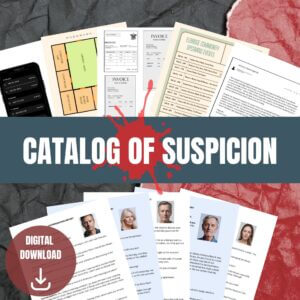
Creators like Print Mysteries have built on this model, producing printable murder mystery case files that include interrogation transcripts, photographs, newspaper clippings, and cryptic codes – delivered digitally and printable at home within minutes of purchase. Their format – 1 to 4 players, multiple objectives with online hint systems – exemplifies the modern printable case file format at its most polished.
What’s Next: Key Trends Shaping the Sector
1. AI-Generated & Dynamic Narratives
Companies in the murder mystery games market are focusing on developing innovative products, such as puzzle mystery games, to provide a blend of critical thinking, immersive storytelling, and interactive problem-solving to challenge and entertain players.[9] The next frontier is AI-generated narratives that adapt to player choices in real time – creating a mystery that is different every time.
2. Augmented & Virtual Reality
Technological innovations such as augmented reality and mobile app developments are enhancing the user experience by providing interactive storylines. The adoption of VR-enabled immersive mystery games stands at 58% in new format launches in 2025, and VR-driven experiences already account for 5% of overall demand – with 27% growth in adoption between 2022 and 2024.[5]
3. IP & Franchise Crossovers
Major brands are entering the space. In October 2024, Hasbro converted its classic board game Clue into “Murder Mystery: Clue” on the Fortnite platform. In November 2024, Beadle & Grimm’s launched Kickstarter campaigns for two murder mystery games inspired by Star Trek.[12] These crossovers significantly expand the addressable audience.
4. Educational Integration
The classroom is becoming a significant growth channel. Integrating learning components within mystery games encourages critical thinking, problem-solving, and group work. Tools like Breakout EDU offer game-based learning opportunities that transform conventional lessons into engaging challenges.[12] Murder mystery games are now used in some universities’ criminal justice programs as training tools.
5. The True Crime Connection
The “true crime” hashtag has over 2 billion views on TikTok and hundreds of millions of posts on Instagram. Over 70% of murder mystery game buyers report being regular listeners or viewers of true crime content. As true crime content continues to proliferate across streaming services and podcasting, it functions as a powerful demand driver for interactive mystery formats.
The Anatomy of a Great Murder Mystery Puzzle Game
Mystery games can vary dramatically in quality. The best titles share a consistent set of design principles – and understanding them helps both players choose well and creators build better.
| Design Element | What It Achieves | Player Impact |
|---|---|---|
| Multiple Objectives | Breaks the game into satisfying milestones rather than one large reveal | Sustained motivation; prevents early disengagement |
| Layered Evidence | Clues build on each other; each discovery unlocks new information | Creates momentum and the “just one more clue” compulsion |
| Well-Developed Characters | Suspects with distinct motives, alibis, and personalities | Emotional investment; harder to dismiss anyone as the killer |
| Plot Twists | Unexpected revelations that reframe prior evidence | Memorable story moments |
| Hint System / Online Answers | Prevents frustration when players are stuck | Reduces dropout; keeps game accessible without spoiling it |
| Realistic Clue Materials | Photographs, documents, coded messages that feel authentic | Immersion; tactile satisfaction; “feeling like a real detective” |
| Appropriate Duration | Most case files designed for 2–3 hours | Respect for players’ time; appropriate pacing per format |
| Flexible Player Count | Games that scale from solo to group play without feeling compromised | Broadens audience |
Over 80% of players report enjoying collaborating with friends or family; solo play is also popular, especially for digital and case file games. The best games accommodate both modes gracefully, offering satisfying solo experiences without penalising smaller groups.
Summary: The Rise of the At-Home Detective
Murder mystery puzzle games occupy a rare position in entertainment: they are simultaneously social and intellectual, passive enough to enjoy with a glass of wine and demanding enough to genuinely engage the prefrontal cortex. That combination – fun plus challenge plus story – explains a trajectory of growth that shows no sign of slowing.
From a market valued at $1.8 billion in 2024 and projected to reach $3.24 billion by 2029, to a player base that now spans 120 million participants in over 70 countries, the murder mystery genre has transcended its niche origins. Driven by the true crime media boom, the experiential entertainment trend, advances in digital delivery, and robust psychological research validating the cognitive benefits of puzzle-solving, the category is firmly mainstream.
If you enjoy solving a printed case file on your coffee table, dressing up for a dinner party, or relaxing with a video game detective story – there’s always something new being released to suit your tastes.
“The skills you pick up from cognitively challenging puzzle games can transfer to other challenging situations in life – and since puzzles are fun, you’re more likely to get more practice in than you would otherwise.”
Vera Tobin, Associate Professor of Cognitive Science, Case Western Reserve University [14]Sources & Citations
- Verified Market Research – Murder Mystery Game Market Size, Share & Scope, 2024. verifiedmarketresearch.com
- Wise Guy Reports – Murder Mystery Games Market: Trends & Growth Analysis 2035. wiseguyreports.com
- Coherent Market Insights – Murder Mystery Games Market Size and Trends 2025–2032. coherentmarketinsights.com
- 360 Research Reports – Immersive Murder Mystery Games Market Size & Share 2034, February 2026. 360researchreports.com
- Data Insights Market – Online Murder Mystery Game Growth Opportunities and Market Forecast 2025–2033. datainsightsmarket.com
- Market Research Intellect – Murder Mystery Game Market Size, Dynamics, Insights and Forecast, 2025. marketresearchintellect.com
- The Business Research Company – Murder Mystery Games Market Insights 2025. thebusinessresearchcompany.com
- Research and Markets – Murder Mystery Games Market Report 2025. researchandmarkets.com
- Wise Guy Reports – Online Murder Mystery Game Market: A Comprehensive Analysis 2035. wiseguyreports.com
- Case Western Reserve University – Mind Games: Discover the Cognitive Impact of Puzzles, 2025. case.edu
- National Institutes of Health (PMC) – Evaluation of Stress and Cognition Indicators in a Puzzle Game, 2022. pmc.ncbi.nlm.nih.gov
- Springer Link – Enhancing Engagement and Analyzing Cognitive Effects in Murder Mystery Board Games, September 2025. link.springer.com
- The National – How Puzzle Video Games Can Improve Brain Health and Focus, May 2025. thenationalnews.com
- Verified Market Reports – Immersive Murder Mystery Games Market Research Report 2032, February 2025. verifiedmarketreports.com
- PMC / NIH – The Effect of Brain Teaser Games on Attention of Players Based on Hormonal and Brain Signal Changes. pmc.ncbi.nlm.nih.gov
- Coherent Market Insights – Murder Mystery Games Market to Reach USD 2.35 Billion by 2032, March 2025. coherentmarketinsights.com