Victorian Murder Mystery Case Files – 19th Century Detective Games
I’d been making modern murder mystery case files for years before starting a historical one. I wanted to do something that was different to every other case out there and something that even more challenging for my customers. Every modern case uses emails, social media posts, and phone records, but I could never find a good reason to add fingerprints to a game when you’d never compare fingerprints in real life, it’s all checked by computer. However, this kind of evidence makes perfect sense in a 19th century story when manual fingerprinting was just becoming a thing.
Why the Victorian Era Works for Detective Games
The 19th century was the perfect time in history for a case in regards to forensics. Fingerprint analysis had just begun in the 1880s – Sir Francis Galton published the first classification system for fingerprints in 1892, and the first criminal conviction based on fingerprint evidence in Britain came in 1902. The London Metropolitan Police, established in 1829, was still relatively young, and forensic science was developing in real time.
That means a Victorian detective would have to solve a case using physical evidence and witness testimonies, and nothing else. There were no phone records. No CCTV. No computers. While this is technically true for every case that’s created, including modern ones, it does give players new types of evidence to explore that’s not the same thing they’ve seen a hundred times.
The class system was also quite interesting to explore. In a Victorian household, the relationships between family members, servants, and business associates were governed by rules that really don’t exist today. A servant couldn’t simply refuse a request. And inheritances played a major role in how relationships between family played out. This creates more interesting motives that are fun to play around with in a story.
And then there’s the evidence itself. Victorian newspapers were not regulated the way modern press is. They published the most bizarre, and obviously false, articles and ads regularly. Similar articles were created for this mystery with many fun articles and ads included. Older types of murder mystery cases have included newspaper article, but always exclude these interesting articles that make the era so interesting. If you want, you can read up more on how the case-file format has evolved so much over the years.
How Victorian Evidence Differs from Modern Evidence
This is the core design difference, and it shapes the whole experience. Here’s a direct comparison of evidence types across formats.
| Evidence Type | Modern Case File | Victorian Case File |
|---|---|---|
| Communication records | Text messages, emails, social media posts | Handwritten letters, telegrams |
| News and public records | Online articles, databases | Newspaper clippings (often sensational) |
| Financial records | Bank statements, receipts | Lledgers, estate documents |
| Physical identity evidence | Security footage, photos | Fingerprints, witness descriptions |
| Medical/forensic evidence | DNA, toxicology reports, autopsy reports | Doctor’s written reports |
| Movement and alibi | GPS data, bus tickets, card transactions | Witness testimony, visitor logs |
The differences in evidence change how players must solve cases. Cases based in times where handwritten notes were more common, can lean into handwriting comparison way more than modern cases where, realistically, most information is sent digitally..
The Design Challenges of Historical Accuracy
Getting the setting right took way longer than any modern case I’d worked on. The main question throughout was: how accurate do I need to be before accuracy starts breaking the game?
Two specific decisions shaped the final product, and both came down to the same question.
The fingerprint problem
Fingerprint analysis was real in the Victorian era, but just barely. The first use of fingerprints as courtroom evidence in England came in 1902. So including fingerprint analysis in a late-1800s case is historically defensible. The first design had them looking like actual smudges. This was very accurate, and yet looked terrible when printed on most home printers.
While I do want my cases to be as realistic as possible, if your printer prints out a fingerprint in a way that you can’t clearly see the lines, that section of the game is essentially ruined. The case needed to work on every printer, not just the most expensive ones. I found new designs for all the fingerprints in Murder at Evercroft Manor that are all much clearer and printer-friendly. Striving for realism should never ruin the enjoyment of a case file.
The newspaper problem
Almost every historical mystery game – board games, physical case files, escape rooms – present Victorian newspapers as yellowed and aged. It looks period-appropriate. Players expect it. But those newspapers would only be yellowed if someone found them in an attic decades later.
In the case of Murder at Evercroft Manor, you’re reading the newspaper the day after it was printed. It wouldn’t be yellowed. A freshly printed Victorian newspaper was white. That’s actually the most accurate version – and it also saves printer ink as you can print the whole case in black and while. Accuracy won, for practical reasons as much as historical ones.
Murder at Evercroft Manor – The Victorian Case File
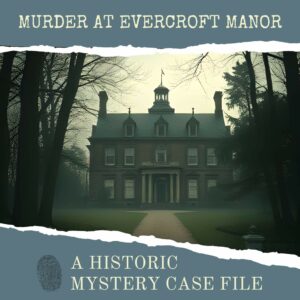
Evercroft Manor is set in 19th century Surrey, which is just outside London. Lord Samuel Evercroft, the owner of a large estate, is found dead in his study. You’re brought in as a consulting detective. There are four suspects, all with access to the estate, all with something to gain from his death, and all with some secret that they want to keep hidden.
The case has seven objectives. After completing each objective, you unlock additional story and evidence. These objectives increase in difficulty as the case progresses. Multiple different pieces of evidence are combined onto each page to keep the page count as low as possible.
This game has a ton of content and is easily a full evening’s investment. Most groups finish in two to four hours. It could easily take longer if you include discussion times. There are 34 optional clues to nudge you along whenever an objective stumps you, so you’re guaranteed to finish the case. These are important in the later objectives where connections between documents aren’t immediately obvious.
Who Victorian Case Files Are For
Players who love a deep story. While Murder at Evercroft was never intended to be so long, the story, characters and puzzles got away from me. If you want a deep and interesting story along, this is the perfect case for you.
Period mystery fans. If you love classic murder mystery novels or TV shows, then this case was designed for you. It’s built on the same bones – old-school evidence, imperfect testimonies, and a household of people who all have means and motive.
Players who want more content than with other cases. Seven objectives is a lot to do, with some objectives having multiple parts to them. This case was designed as an all-evening experience. If a two-hour solve feels too short, this might be the right case for you.
While I enjoy playing case files solo, it also works well for 2-4 players. There’s plenty of evidence for people to divide and discuss, and due to it being printable, you can always print out extra copies so no one is ever waiting to analyze a specific clue.
What Makes Victorian Mysteries Feel Different to Play
With every new case, I try to outdo my previous story and especially my previous puzzles. The Victorian era gave me a fresh new canvas to work on, and challenged me to create clues and puzzles that fit well in that time period. Analyzing fingerprints and handwriting samples fit especially well into these types of cases.
The story and the humor of the Victorian era are what will draw you in the most. The ridiculous newspaper articles from that time period and the way that characters talked and interacted is especially funny when looked at through a modern lens.
Frequently Asked Questions
What is a Victorian murder mystery case file?
A Victorian murder mystery case file is a detective case file that’s set in the 19th century. Players have to solve a murder using period-accurate evidence such as handwritten letters, newspaper articles, fingerprint analysis, doctor’s reports, etc. instead of digital evidence that’s most common in modern case files. The game is downloaded as a PDF, printed at home, and can be played alone or with a small group. It doesn’t require any acting, or costumes as it’s a case file and not a murder mystery dinner party game.
How is a Victorian case file different from a modern one?
The types of evidence you’ll deal with are the biggest difference. Modern case files use emails, social media posts, phone records, etc. Victorian/historic cases use handwritten letters, old maps, estate documents, etc. It gives players fun and unique new pieces of evidence to play with.
Do you need background knowledge of the Victorian era to play?
No. The case file provides everything you need to understand the setting and the relationships between all the characters. The PDF has everything on it that you’ll need to solve the case.
Are Victorian murder mystery case files harder than modern ones?
Not necessarily. Every game is given a difficulty rating. These are standard across both modern and Victorian/historic cases. This case in particular is rated as a Medium/Hard case. It’s designed to be challenging but fun. Optional clues are provided so you’ll never be completely stuck.
How long does a Victorian murder mystery case file take to solve?
Murder at Evercroft Manor, the Victorian case file in this collection, usually takes two to four hours. Your time will vary depending on your skill level and the number of people you play with. It’s currently the longest case in the collection. It’s best to keep a full evening free.
Were fingerprints actually used in Victorian detective work?
Yes, though they were just emerging as a forensic tool around this time. Sir Francis Galton published his fingerprint classification system in 1892, and the first conviction based on fingerprint evidence in Britain came in 1902. A case set in the late 1800s can plausibly include fingerprint analysis as it sits at the exact time when this technique was first being applied in real criminal investigations.